
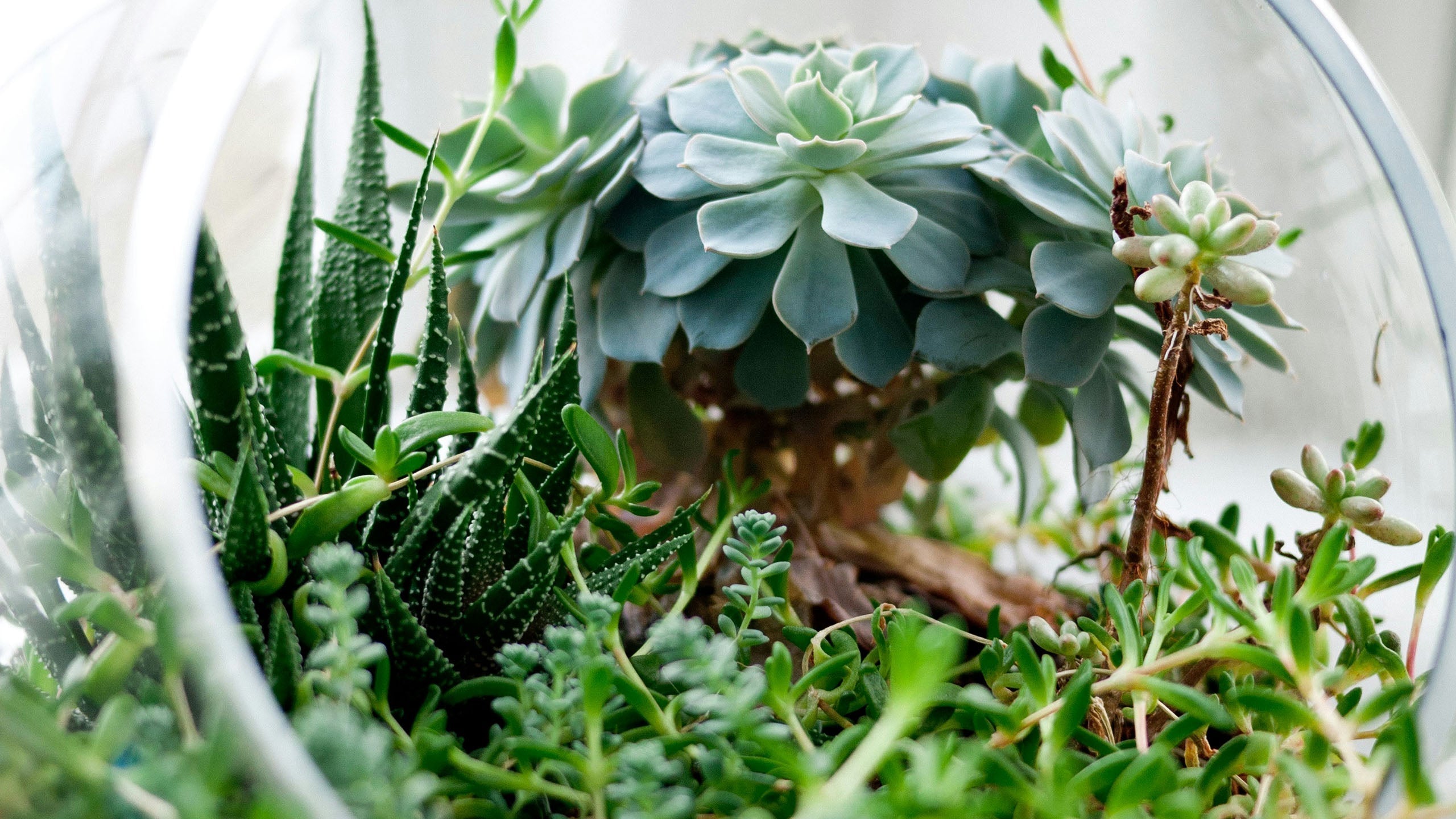
Un terrarium en verre apporte un système végétal vivant dans votre maison. Il combine la terre, les plantes, l'humidité et la lumière dans un environnement clos. Au fil du temps, les surfaces en verre perdent de leur clarté. Des marques d'eau se forment, des algues se développent et des résidus de terre s'accumulent à l'intérieur du récipient. Ces changements affectent l'apparence et reflètent souvent des déséquilibres dans le système.
Apprendre à nettoyer un terrarium en verre vous aide à protéger la santé des plantes tout en conservant la clarté de l'affichage. Le nettoyage doit soutenir les racines, les couches de mousse et la structure du sol sans les perturber.
Un terrarium fonctionne comme un petit écosystème où l'humidité circule par évaporation et condensation. Les plantes libèrent de l'eau dans l'air, le verre la retient et le système la recycle. Le jardin botanique du Missouri explique cette structure sur leur site web.
ecostems conçoit des systèmes de plantes d'intérieur à travers Toronto en mettant l'accent sur l'équilibre à long terme, la santé des plantes et la clarté visuelle. Ce guide explique comment nettoyer un terrarium en verre sans endommager les plantes.
Comprendre votre terrarium en verre
Un terrarium en verre fonctionne comme un environnement végétal contrôlé. Il maintient l'humidité, réduit le stress extérieur et crée des conditions de croissance stables.
Un terrarium de plantes en verre contient souvent des plantes tropicales, de la mousse et de la terre en couches. Un terrarium d'intérieur peut être posé sur des bureaux, des étagères ou des tables et servir de pièce décorative vivante. Les systèmes ouverts permettent la circulation de l'air, tandis que les systèmes fermés retiennent l'humidité.
Les terrariums fermés retiennent l'humidité pendant de longues périodes. Les terrariums ouverts sèchent plus rapidement et nécessitent un nettoyage plus fréquent de la surface. Les terrariums désertiques utilisent des systèmes de sol sec avec des plantes grasses ou des cactus et nécessitent un contrôle minimal de l'humidité.
Chaque système utilise des couches telles que des pierres de drainage, du charbon actif, du terreau, de la mousse et des matériaux décoratifs. Ces couches affectent le mouvement de l'humidité et influencent la rapidité avec laquelle les résidus se forment sur le verre.
Les terrariums en verre rassemblent ces systèmes dans des conceptions soignées qui équilibrent la structure, les plantes et les besoins d'entretien à long terme.
Pourquoi les terrariums en verre développent-ils des résidus ?
Les résidus se forment naturellement à l'intérieur des terrariums. Cela n'indique pas un échec. Cela reflète les conditions d'humidité, de circulation d'air et de lumière.
Les causes courantes comprennent :
- Condensation qui laisse des marques minérales après évaporation
- Un arrosage excessif qui augmente trop les niveaux d'humidité
- Croissance d'algues due à une forte lumière et à des surfaces humides
- Développement de moisissures dans des conditions de circulation d'air stagnante
- Mouvement du sol pendant l'arrosage ou les ajustements des plantes
La qualité de l'eau affecte également la clarté du verre. L'eau dure laisse des traînées minérales en séchant. L'accumulation d'engrais peut également laisser des résidus dans les systèmes clos si elle n'est pas gérée avec soin.
Les systèmes de terrarium végétal dépendent d'un équilibre entre l'humidité, la lumière et la circulation d'air. Lorsque l'humidité reste élevée trop longtemps, le verre s'embue. Lorsque la lumière augmente sans circulation d'air, les algues se propagent plus rapidement.
Les conseils de jardinage en conteneurs de The Spruce soulignent l'importance de l'hygiène et de l'équilibre hydrique dans les systèmes plantés.
Les fournitures de terrarium telles que le mélange de terreau, les couches de charbon et les matériaux de drainage affectent également la rapidité d'apparition des résidus.
Outils pour nettoyer un terrarium en verre
Le nettoyage d'un terrarium en verre nécessite des outils doux qui protègent les plantes et les systèmes du sol.
Les fournitures de terrarium utiles comprennent :
- Chiffon en microfibre pour le nettoyage extérieur du verre
- Chiffon doux non pelucheux pour les surfaces intérieures
- Longue pince à épiler pour le repositionnement des plantes
- Petite brosse de détail pour les coins et les zones difficiles d'accès
- Cotons-tiges pour un nettoyage ciblé
- Vaporisateur rempli d'eau distillée
- Brosse à dents souple pour les taches d'algues sur le verre
Les accessoires de terrarium conçus pour la précision réduisent les perturbations à l'intérieur du système. L'eau distillée aide à réduire les traînées minérales par rapport à l'eau du robinet.
Évitez les nettoyants chimiques. Les produits contenant de l'ammoniaque ou de l'alcool endommagent la mousse, les microbes du sol et les tissus végétaux.
L'entretien des terrariums d'intérieur fonctionne mieux avec des outils simples qui permettent le contrôle plutôt que la force. Les produits de nettoyage puissants perturbent l'équilibre à l'intérieur des systèmes clos.
Les systèmes de terrarium ecostems utilisent des conceptions en couches qui favorisent la stabilité, ce qui réduit la fréquence des nettoyages en profondeur.
Méthode étape par étape pour nettoyer un terrarium en verre
Le nettoyage d'un terrarium en verre nécessite un processus minutieux qui protège les systèmes végétaux tout en restaurant la clarté.
Étape 1 : Vérifier l'état du système
Observez l'humidité du sol, la posture des plantes et les niveaux de condensation. Si le sol semble trop humide, reportez le nettoyage.
Étape 2 : Nettoyer la vitre extérieure
Essuyez les surfaces extérieures avec un chiffon en microfibres. Enlevez les empreintes de doigts, la poussière et les taches d'eau avant d'ouvrir le récipient.
Étape 3 : Ouvrir l'accès avec précaution
Retirez les couvercles ou ouvrez les points d'accès lentement. Évitez de secouer ou d'incliner la structure.
Étape 4 : Nettoyer la vitre intérieure
Utilisez un chiffon humide ou un coton-tige. Travaillez de haut en bas. Évitez d'appuyer sur le sol ou les couches de mousse.
Étape 5 : Traiter les taches d'algues ou de moisissure
N'appliquez une légère pression que sur les zones affectées. Une croissance importante signale souvent un déséquilibre d'arrosage ou de lumière plutôt qu'un simple problème de nettoyage.
Étape 6 : Ajuster le positionnement des plantes
Utilisez une pince à épiler pour repositionner les feuilles ou les tiges qui touchent la vitre ou bloquent la circulation de l'air.
Étape 7 : Équilibrer l'humidité
Si la condensation est abondante, laissez le récipient ouvert brièvement. Les terrariums fermés doivent conserver une certaine humidité, alors évitez de trop les dessécher.
Étape 8 : Restaurer la disposition
Replacez délicatement les pierres, la mousse ou les éléments décoratifs. Maintenez la structure d'origine intacte pour préserver le drainage et la stabilité.
L'expression « comment nettoyer un terrarium en verre » s'applique à ce processus d'entretien contrôlé qui protège à la fois la santé des plantes et la clarté du verre.
Nettoyage des différents types de terrariums
Chaque type de terrarium réagit différemment au nettoyage.
Les terrariums en verre fermés retiennent l'humidité et nécessitent un contrôle minutieux de la condensation. Les terrariums ouverts se concentrent sur le dépoussiérage et un nettoyage léger des surfaces. Les terrariums désertiques utilisent des systèmes de sol sec et nécessitent une perturbation minimale de l'humidité.
Les terrariums à plantes aériennes reposent sur la circulation de l'air plutôt que sur le sol. Le nettoyage se concentre sur la clarté du verre et l'élimination de la poussière plutôt que sur l'entretien interne.
Les terrariums désertiques conviennent aux personnes qui souhaitent des systèmes nécessitant moins d'entretien avec une réduction de la condensation.
Les terrariums à plantes aériennes réduisent les besoins de nettoyage liés au sol et se concentrent davantage sur la clarté de l'affichage et la circulation de l'air.
Chaque système nécessite une approche de nettoyage différente en fonction du type de plante et du niveau d'humidité.
Erreurs courantes à éviter
De nombreux problèmes proviennent d'un nettoyage excessif ou de méthodes incorrectes.
Évitez :
- Les nettoyants chimiques à l'intérieur des systèmes de plantes fermés
- De déranger les racines pendant le nettoyage des vitres
- D'ajouter de l'eau immédiatement après le nettoyage
- De retirer trop d'humidité dans les systèmes fermés
- De frotter les surfaces de mousse ou de sol
- De nettoyer sans vérifier l'état du système
Les systèmes de terrariums végétaux reposent sur l'équilibre microbien dans les couches du sol. Cet équilibre soutient le cycle des nutriments et la croissance des plantes. Un nettoyage agressif perturbe cet environnement.
Les accessoires de terrarium doivent favoriser le contrôle et la précision plutôt qu'un entretien agressif.
Quand rafraîchir ou reconstruire un terrarium
Certains terrariums arrivent à un point où le nettoyage ne restaure plus la clarté ou la santé des plantes.
Les signes incluent :
- Une croissance répétée de moisissures
- Un embuage constant à l'intérieur du verre
- Une dégradation de la santé des plantes sur plusieurs espèces
- Un effondrement de la structure du sol
- Des systèmes racinaires envahis
À ce stade, la reconstruction du terrarium donne de meilleurs résultats qu'un nettoyage répété.
Si vous souhaitez acheter des systèmes de terrariums ou explorer les terrariums à vendre à Toronto, les designs sélectionnés offrent une meilleure structure et une stabilité à plus long terme.
Produits vedettes pour terrariums

Terrarium en verre de désert type bocal à poisson
Ce système désertique utilise des plantes nécessitant peu d'eau, ce qui réduit la condensation et aide à maintenir des surfaces vitrées plus claires et à simplifier l'entretien des plantes d'intérieur.

Terrarium sphérique suspendu pour plantes aériennes
Ce système à air libre utilise la circulation de l'air au lieu du sol, ce qui réduit le risque de moisissure, simplifie le nettoyage du verre et offre une manière simple d'exposer les plantes aériennes avec un entretien minimal.
Maintenir un terrarium propre à long terme
La clarté à long terme dépend d'un entretien régulier plutôt que de séances de nettoyage intensives.
Utilisez cette approche :
- Vérifier les niveaux d'humidité chaque semaine
- Essuyer la vitre extérieure toutes les une à deux semaines
- Enlever les algues tôt avant qu'elles ne se propagent
- Ajuster l'exposition à la lumière pour gérer la condensation
- Utiliser de l'eau distillée pour réduire l'accumulation de minéraux
- Éviter l'arrosage excessif après le nettoyage
Les accessoires de terrarium, tels que les outils d'arrosage de précision, aident à contrôler les niveaux d'humidité et à réduire l'accumulation.
Les terrariums en verre restent plus propres lorsque la lumière, l'eau et la circulation de l'air restent constantes. Des conditions stables réduisent la formation de résidus et favorisent la santé des plantes.
Conclusion
Le nettoyage d'un terrarium en verre favorise à la fois la santé des plantes et la clarté visuelle. Des méthodes soigneuses protègent les racines, les couches de sol et l'équilibre de l'écosystème.
Chaque type de terrarium nécessite une approche différente. Les systèmes désertiques, les installations de plantes aériennes et les terrariums de plantes en verre réagissent tous différemment à l'humidité et à la circulation de l'air.
Si vous souhaitez des systèmes conçus pour un entretien plus facile, explorez les terrariums en verre, les terrariums désertiques et les terrariums de plantes aériennes ecostems à Toronto.
